Tree Service in Southwest Wichita
Tree Service for Southwest Wichita homes - local conditions, a clear process, and one call to get it started.
Ask what makes tree service local in Southwest Wichita and the answer is geography: the same trade, a different map.
Tree work in Southwest Wichita starts with the sky. Wichita sits in storm country, where spring wind tests every union in a single afternoon, winter ice loads every limb, and the summer bake stresses whatever both leave behind. General tree service here means knowing which of those three your tree is losing to before choosing the work.
Southwest Wichita spreads along K-42 toward the county line, a mix of postwar neighborhoods, newer subdivisions and semi-rural lots near the Cowskin Creek bottoms. Lake Afton, the county park lake, sits just beyond its edge, and the tree cover shifts from yard plantings to creek-bottom timber as the streets thin out.
The details of the neighborhood matter for this work. Postwar homes, newer subdivisions and acreage properties with shelterbelts and creek timber - and that shapes the tree work directly. Two tree worlds meet here: yard trees in the subdivisions, and bottomland timber along Cowskin Creek - cottonwood, pecan, walnut and Osage orange standing in ground that stays wet. For tree service in Southwest Wichita, for full-service care, the visit works the whole tree - crown, trunk, roots and the ground it stands in.
Southwest Wichita's character is easiest to read at the K-42 corridor and the Cowskin Creek bottoms, where the neighborhood's age, exposure and planting stock all show at once.
Signs Southwest Wichita Homes Need Tree Service
Limbs over the roof and lines
Branches resting on shingles, rubbing the roof edge or sitting in the service line are damage in progress, not a someday problem - and storm wind finishes the contact.
A trunk that leans more than it did
A new or growing lean, especially with soil lifting on the far side, means the root plate is losing its argument with the wind.
Fungus at the base
Mushrooms or conks at the trunk's foot or on surface roots mean decay is established inside the wood - the tree's structure is being spent from within.
Why This Work Runs in Southwest Wichita
The second engine is the species calendar. The planting fashions of each decade are reaching their failure years together: the Bradford pears of the eighties and nineties splitting at their unions, the green ash standing in the emerald ash borer's path, the silver maples hollow at the base. Much of Wichita's tree work is this arithmetic arriving, street by street.
Two tree worlds meet here: yard trees in the subdivisions, and bottomland timber along Cowskin Creek - cottonwood, pecan, walnut and Osage orange standing in ground that stays wet. Creek trees lean and shed; acreage shelterbelts of aging Siberian elm and cedar are failing row by row. Clearing and dead-tree removal run steady on the rural edge.
In Southwest Wichita, that plays out street by street - for full-service tree care, the assessment decides which trades the tree actually needs. On the Southwest Wichita run, crews read the bases first - the fungus and flare story is the fastest route to the truth in this neighborhood.
Fall is the assessment and planting window. The severe season is past, the canopy shows its true structure as the leaves thin, and there is time to cable what can be kept, remove what cannot, and plant replacements while the soil is still warm. It is also when honest tree work happens, because a bare-crowned tree hides nothing from an arborist.
Two things decide how much a visit accomplishes: access and honesty. Access means the crew can reach the trees, the gates and both side yards. Honesty means the full history - the limb that fell two summers ago, the crack that opened last winter, the treatment from three owners back. With both, the first visit usually settles the diagnosis for good.
This season, the watch item in Southwest Wichita is the sky: every spring cell that builds over the plains grades the canopies below it, and the yards near the K-42 corridor and the Cowskin Creek bottoms read the results first.
One more preparation that matters on the plains: tell the office about any lines through the canopy, septic fields or new concrete on the property. What is under and over the tree shapes the method more than most homeowners expect.
How Tree Service Works in Southwest Wichita
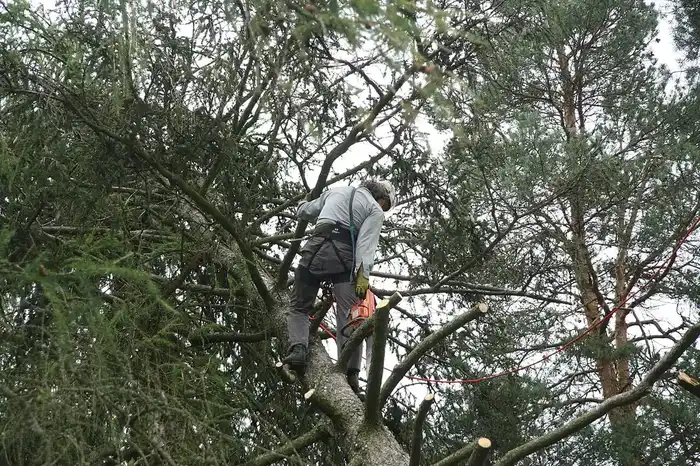
The full step-by-step process for this service - inspection, scope, the work itself and follow-up - is laid out on the main Tree Service page. In Southwest Wichita the same sequence runs with the local map in hand: the canopy around the K-42 corridor and the Cowskin Creek bottoms, the housing pattern described above, and the exposure this neighborhood actually carries.
The Southwest Wichita Angle
What makes Southwest Wichita different is not the work; it is the setting - plains wind, ice and storm tracks, arranged by one neighborhood's geography. Housing here tells the arborist where to look first. Postwar homes, newer subdivisions and acreage properties with shelterbelts and creek timber.
Layer the treetops on top and the job defines itself. Two tree worlds meet here: yard trees in the subdivisions, and bottomland timber along Cowskin Creek - cottonwood, pecan, walnut and Osage orange standing in ground that stays wet. Creek trees lean and shed; acreage shelterbelts of aging Siberian elm and cedar are failing row by row. Clearing and dead-tree removal run steady on the rural edge. Which is the whole method: read Southwest Wichita first, then do tree service work that fits what the reading found.
Southwest Wichita does not sit alone on the map. It weathers the same storms as West Wichita, South Wichita and Delano - the same cells cross the county, the same wind works the same canopies, and the same seasons move through all of them within the same few weeks. Homes on these blocks share crews, routes and seasons - which is why a tree solved properly on one street tends to stay solved.
On the route map, Southwest Wichita sits in the wichita neighborhood group, ZIP 67217 - close enough to West Wichita, South Wichita that crews work them on the same runs. That local memory is the quiet advantage of route-based work in Southwest Wichita.
Experience in these blocks has a favorite saying: the storm finds what the owners skipped. It is unfair only in the sense that weather always is - and it is why the kept yards of Southwest Wichita look, from the street, like nothing ever happens there.
Prevention That Helps in Southwest Wichita
- Never let anyone top your trees - the regrowth is weaker and faster than what came off.
- Water young trees deeply through summer dry spells; new roots are shallow roots.
- Keep mulch in a wide, flat ring over the roots, never piled against the trunk.
Postwar homes, newer subdivisions and acreage properties with shelterbelts and creek timber.
Keep Exploring
Tree Service nearby:
- Tree Service in West Wichita
- Tree Service in South Wichita
- Tree Service in Delano
- Tree Service in Auburn Hills
More services in Southwest Wichita:
- Hedge & Shrub Trimming in Southwest Wichita
- Emergency Tree Service in Southwest Wichita
- Tree Trimming & Pruning in Southwest Wichita
- Stump Grinding in Southwest Wichita
See the full tree care page for Southwest Wichita and the Tree Service overview for Wichita.
Tree Service in Southwest Wichita - Questions
Does the species of my Southwest Wichita tree change the advice?
Completely. An ash is read for the borer, a Bradford pear for its unions, a silver maple for its base, an oak for its structure and timing. Advice that ignores the species is generic, and generic tree advice fails in the first storm.
What does a general tree service visit in Southwest Wichita actually cover?
It covers an assessment of the trees on the property - structure, crown health, trunk and root condition, and what stands under them - then a plain-language plan: what to prune now, what to watch, what to treat, and what has reached the end of its safe life.
What should Southwest Wichita homeowners have ready before a Tree Service visit?
Access and information. Clear the way to the trees and the gates, secure pets, and have the pattern written down - when it started, where it shows, and what the weather was doing. That five minutes of prep is worth a second visit.
A Dead Limb Over the Roof, a Leaning Trunk or Storm Debris in the Yard?
One call connects you with a tree care professional serving Wichita and the surrounding communities - assessment, trimming, removal and cleanup.
📞 Call Now