Tree Service Through the Wichita Year
Summer splits in two: the storm tail of June and early July, when late cells still tear at crowns, and the long bake that follows, when drought stress shows first in the trees planted in tight soil and parking-lot islands. Most storm damage is discovered in summer - the storm did the work in spring, and the failures report as the heat and wind finish them. Deep watering of young trees is the season's quiet essential.
Fall is the assessment and planting window. The severe season is past, the canopy shows its true structure as the leaves thin, and there is time to cable what can be kept, remove what cannot, and plant replacements while the soil is still warm. It is also when honest tree work happens, because a bare-crowned tree hides nothing from an arborist.
Spring is storm season in Wichita, and it is tree season too. From March into June, supercell thunderstorms roll off the plains with damaging wind, and the trees that get a structural look before the season are the ones that come through it standing. Late spring is also when winter's hidden damage declares itself - limbs that died under ice, crowns that leaf out thin, and borers resuming their work in the ash.
Tree Service in Depth
The useful way to think about a Wichita yard is as a portfolio of structures on different clocks: the oak planted in 1960 with eighty years left in it, the pear from 1995 on its final unions, the ash whose borer clock started the day the beetle reached the county. General tree service is the discipline of reading all of those clocks at once and spending the owner's money where the risk and the value actually sit.
That is why good tree care advice always starts with the walk, tree by tree. The right job for a given tree - prune, treat, cable, remove, or deliberately leave alone - is not a sales category; it is the output of its grade. Owners who learn to ask for the grades, and the reasoning behind them, make better tree decisions than owners who ask only for a total, because the total hides everything that matters.
Choosing the Right Help
Choose the tree professional the way you would choose anyone who works on a structure you live under: by the quality of the diagnosis. Ask what they found in your trees and what they ruled out; ask what they would do if the trees were theirs; ask what they recommend not doing. A crew whose answers name your species, your defects and your storm exposure - and who will put the plan in writing - is a crew whose saws you can trust when the plan calls for them.
The Climate Behind It
Wichita sits on the central Kansas plains where the Arkansas and Little Arkansas rivers meet, and plains weather writes the tree calendar here: spring severe storms with damaging wind, winters that deliver canopy-breaking ice, and long summer droughts broken by downpours. A tree in Wichita is not tested by one climate - it is tested by all of them, in turns, every year of its life.
Wind is the signature force. Kansas wind works at trees day after day - flagging crowns, fatiguing weak unions - and storm outflows arrive with gusts that collect on whatever the daily wind loosened. A tree's structure, built by its pruning history or its neglect, is its real storm rating, whatever species the tag said.
How Tree Service Works
Walk the whole property
The visit covers every tree that matters - structure, crown, trunk, root flare and targets below - so the plan starts from evidence, not from the one tree you called about.
Sort keep, treat and remove
You hear plainly which trees are sound, which need work or treatment, and which have reached the end - and why, tree by tree.
Do the work in the right order
Hazards first, structure second, cosmetics last. A dead limb over the roof outranks a shaping pass every time.
Leave a care rhythm
You get the findings in plain language and the check-back timing that fits your trees and this storm calendar.
Doing It Yourself vs a Professional
The DIY Route
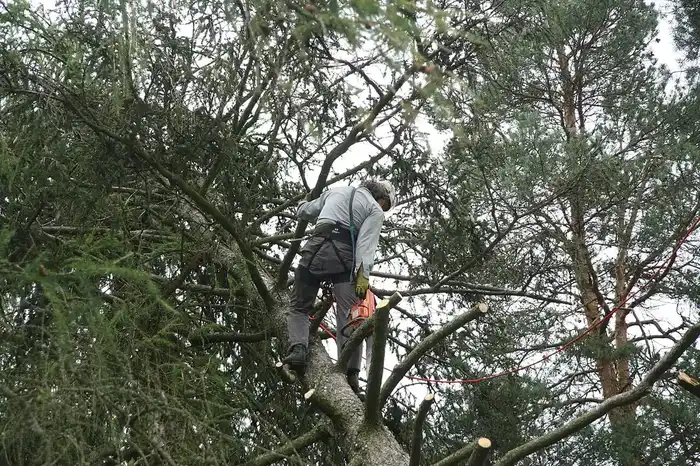
- A ladder and a chainsaw combine into the most common tree-work injury story there is
- Cutting a big limb in one piece tears the bark down the trunk and can drop the limb on the cutter
- Topping feels like control and produces the opposite - weak, crowded regrowth on a decaying stub
VS
The Professional Route
- Starts with a full assessment and a named plan for each tree
- Cuts by the tree's structure - collar cuts, reduction cuts - not by the hour or the load
- Matches the method to the tree and the site: ropes and rigging where a lift cannot go
Keep It From Coming Back
Most of what keeps Wichita trees alive is unglamorous and inexpensive, done on a rhythm: mulch kept right, water in the drought, weak unions read early, deadwood taken before the wind takes it. The list below is the standing discipline for any yard in this county - the habits that decide whether the big trees underneath ever get their full life.
- Walk your trees every spring at leaf-out - look for limbs that never leaf and crowns coming back thin.
- Keep mulch in a wide, flat ring over the roots, never piled against the trunk.
- Water young trees deeply through summer dry spells; new roots are shallow roots.
- Have weak unions looked at before storm season, not after the split.
- Photograph your trees after big wind or ice so changes are easy to spot later.
- Never let anyone top your trees - the regrowth is weaker and faster than what came off.