After the Storm: A Wichita Guide to Storm-Damaged Trees
Storm damage keeps unfolding after the sky clears: hangers fall, splits open, and root plates settle for days - the first walk should be a look, never a cleanup.
Read the Guide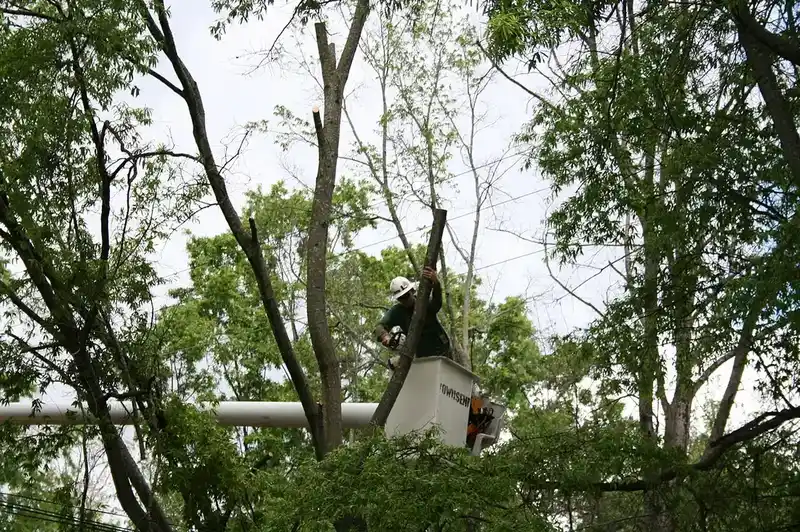
Ice adds hundreds of pounds to every limb, and it collects on the defects the tree already had - split unions, dead tops, end-heavy limbs fail first and loudest.
Problem: Ice adds hundreds of pounds to every limb, and it collects on the defects the tree already had - split unions, dead tops, end-heavy limbs fail first and loudest.
Solution: Survival is decided in the calm seasons: structural pruning, balanced crowns, and species choices; during the storm itself, the only safe move is distance.
When to call: Call when the melt reveals split trunks, hanging limbs or a new lean - and before the next ice season, for the structural pass on every tree over a target.
Kansas ice storms are the canopy's true examinations. Wind gets the headlines, but ice does the methodical work: a half-inch of radial ice multiplies a limb's weight many times over, and the load sits there, silent, for days - until a union gives with a crack the whole street hears. The great Kansas ice storms have rewritten whole neighborhoods' canopies in single nights. This guide explains what the ice is testing, and how your trees pass.
Wind is the signature force. Kansas wind works at trees day after day - flagging crowns, fatiguing weak unions - and storm outflows arrive with gusts that collect on whatever the daily wind loosened. A tree's structure, built by its pruning history or its neglect, is its real storm rating, whatever species the tag said.
Ice accretes on every surface it can freeze to - twigs first, which multiply a crown's surface area beyond reckoning. A mature tree can carry thousands of pounds of ice, distributed with cruel fairness: the load is greatest exactly where the leverage is greatest, at the limb ends. Wood that carries summer's leaf weight easily is suddenly holding a frozen second tree, in a material state - frozen, brittle - least suited to surprises.
Failure follows the defect map the tree brought to the storm. Co-dominant unions with included bark unzip. Dead tops, which contribute load and no strength, snap and spear downward. Long limbs pruned by topping throw their weak regrowth first. And whole trees with compromised root plates go over entire, ice and all, when the crown's new weight meets a gust. The storm does not create these weaknesses in a night; it audits them.
Wood and architecture decide the roll. Bradford pear, silver maple, Siberian elm and willow - fast, weak-unioned, brittle - fail in ranks. Bur oak, hackberry, Kentucky coffeetree and the better elms bend, shed their smallest wood, and stand. Within a species, the trained tree outlasts the wild one: a single-leader crown with spaced, well-attached limbs presents less ice sail and fewer leverage traps than a many-forked crown of the same age.
This is why ice country plants and prunes the way it does. Species selection is a fifty-year bet on a wood's character; structural pruning is the annual premium on the same policy. Wichita's older streets demonstrate both halves - the pears and silver maples planted for fast shade have been exiting, storm by storm, while the slow oaks planted the same years now hold the canopy's value.
During the storm: nothing. No shaking limbs (frozen wood snaps and drops without the courtesy of a warning bend), no working under loaded crowns, no heroic rescues of bent trees. Bent young trees often recover as the melt unloads them; the urge to intervene while they are loaded is how owners join the damage report. Let the ice leave on its own schedule and keep the yard empty until it has.
After the melt, the assessment walk: hangers in the crowns, splits that opened, trunks newly leaning, crowns with a third of their wood on the ground. Damaged trees get corrective pruning - torn stubs to collars, split verdicts rendered honestly - and the survivors get their structural pass scheduled, because the lesson of every Kansas ice storm is that there will be another Kansas ice storm, and it reads from the same defect map.
Beyond species reputation, the documents that matter for a young tree's storm future are its structure as planted: one leader or several, the spacing of its scaffold limbs, the presence of included bark at its first unions. Check the nursery stock the way an arborist does - reject the multi-leader oak at the garden center, however full it looks, because its split is already scheduled and merely awaits its ice.
Keep the planting records with the property file: species, source, date, and the pruning log as it grows. Years later, they are how the tree's storm performance gets explained - and how the insurance and the next owner read the same story the arborist reads in the wood.
Every ice storm leaves the same poignant row: young trees bent double, owners certain they are lost. The record says otherwise for a surprising share - flexible young wood, unloaded slowly by the melt, rises over days and weeks, sometimes with a prop's help set after the melt, and the tree resumes with a sweep in its trunk that becomes character. The verdict's timing is the skill: no judgment while loaded, no saw until the tree has had its fortnight to testify.
The exceptions declare themselves plainly: bark wrinkled or cracked on the bend's inside, a trunk that does not rise at all as the ice leaves, roots lifted on the far side. Those trees get their honest ending. The rest get patience - the simplest input in all of tree care, and the one storm week makes scarcest.
Pruning has a mathematics owners rarely hear: every cut removes leaf area, and leaf area is income. A tree pruned within its budget spends the season growing and closing wounds; a tree pruned past it spends the season surviving - throwing weak watersprouts, sunburning its own bark, falling behind on the energy that fights borers and drought. The skilled pass is measured not by what is on the ground afterward but by how the crown looks in three years.
That is the service side of this guide's subject. When you are ready, the Tree Trimming & Pruning page carries the process, the coverage by neighborhood and the number to call.
During the ice, the yard under any crown is closed - no exceptions for vehicles, pets or curiosity.
Bent trees get their chance to rebound unloaded before any verdict; frozen wood gets nobody's saw.
Hangers, splits, leans and crown losses - documented while the evidence is fresh.
Corrective cuts for the damaged, structural passes for the survivors, removals for the failed - scheduled before the season returns.
Walk the canopy after every melt with binoculars: hangers hide at height.
Photograph bent trees daily for a week before judging them - the rise is the verdict.
Book the survivors' structural pass before the next ice season, not after it.
dates, photos, verdicts - the next storm's crew starts from it.
An ice-readiness assessment delivers a per-tree defect map: unions graded, deadwood and end-weight inventoried, heritage defects evaluated for cabling, and a work order ranked by what the next load would collect first - with photographs that let any second arborist re-measure the same tree.
After a storm, the same file format becomes the damage report: what the ice took, what it weakened, what it merely photographed badly - so cleanup money lands on the trees the storm actually changed.
A professional ice-readiness program is a defect hunt run in the calm seasons: every tree over a target gets its unions graded, dead tops removed, end-weight reduced and heritage defects cabled on the record - so the storm's audit, when it comes, finds a canopy whose known weaknesses were retired in advance. The program's paperwork is the point: after the storm, the same file tells the crew exactly which trees the ice could still surprise.
Shaking or striking loaded limbs to 'help' - frozen wood answers with breakage, downward.
Topping after the storm to lighten the tree - manufacturing the next failure set.
Judging bent young trees during the load and cutting the recoverable.
Planting another brittle, fast species in the gap because it shades quickly - it fails quickly, too, on the same calendar.
Ice does not negotiate, but it does announce its syllabus: unions, deadwood, end-weight, brittle species. Every item on it is addressable in the calm seasons, at calm-season prices, on calm-season schedules. The canopy that passes the next audit is being decided this year - in the pruning calendar, not in the storm.
Storm damage keeps unfolding after the sky clears: hangers fall, splits open, and root plates settle for days - the first walk should be a look, never a cleanup.
Read the GuideTrees announce their decline in order: the crown thins and shortens first, the trunk shows seams and fungus, the base tells the final truth - most owners read the list backwards.
Read the GuideSurprisingly often, no - young and mid-size trees of flexible species can bend astonishingly and recover fully as the melt unloads them, sometimes over weeks. The verdict waits for the melt and a week of watching: if the trunk is uncracked and the tree rises steadily, it gets its chance. Trees that stay bent, or show bark wrinkles and cracks from the bend, have a structural story instead.
No. Frozen limbs are at their most brittle, and striking or shaking them breaks wood that would have survived, and drops ice and limbs onto the person helping. The kindest act during accretion is distance. Support for a valued young tree is arranged before storms, with props set from the ground in calm weather - never improvised under a loaded crown.
It depends on where the split ran and how much of the crown each half holds. Early splits at a union, in an otherwise sound tree, can be braced with rods and cables and reduced in load. A split that ran down the trunk's heart, or that involves decay in the seam, is a removal the storm merely announced. The assessment reads the seam - this is the single most consequential read of the ice season.
You do not proof it; you grade it. Structural pruning that removes the defects ice exploits, species chosen for wood strength at planting, deadwood kept out, and weak unions cabled or removed young - layered together, these move a tree from the storm's casualty list to its survivor list with high reliability. No such promise exists; the odds, though, are very improvable.
One call connects you with a tree care professional serving Wichita and the surrounding communities - assessment, trimming, removal and cleanup.
📞 Call Now