Signs a Tree Is Dying: A Wichita Homeowner's Checklist
Trees announce their decline in order: the crown thins and shortens first, the trunk shows seams and fungus, the base tells the final truth - most owners read the list backwards.
Read the Guide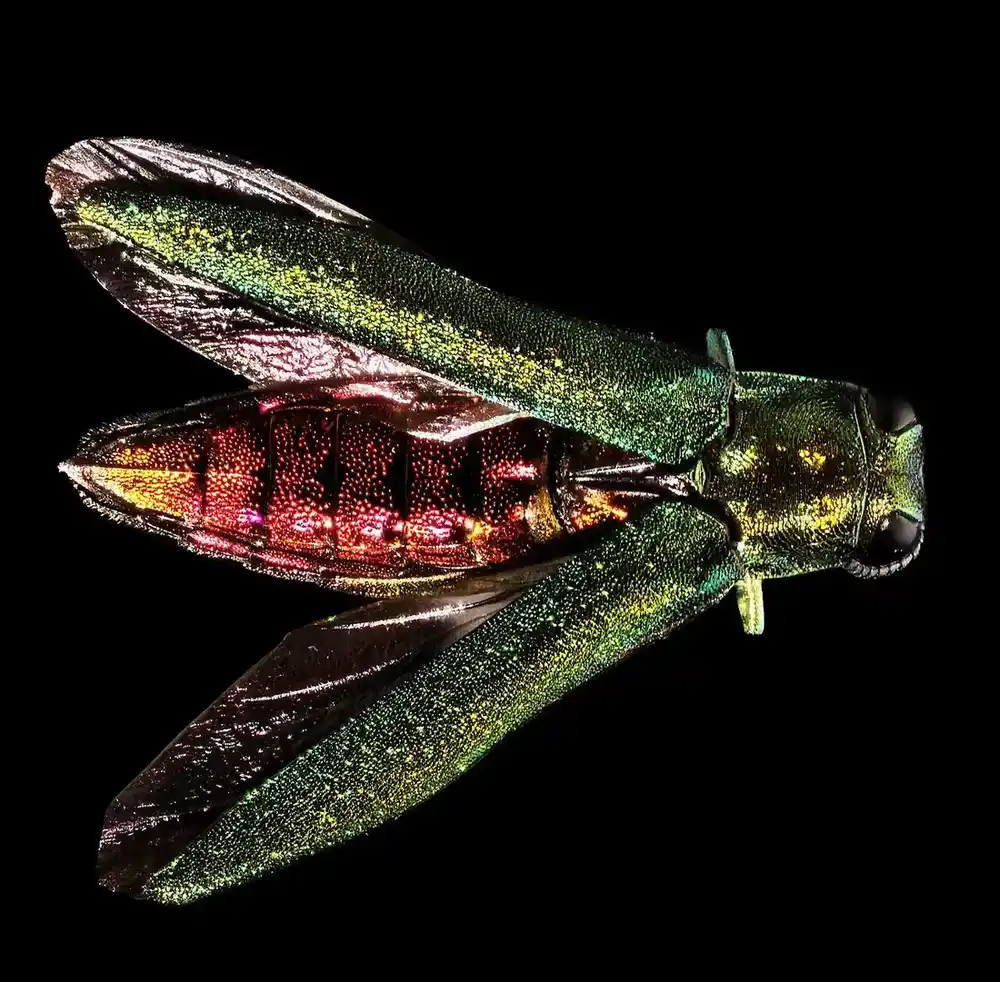
The emerald ash borer kills from inside: larvae cut the tree's plumbing under the bark, and the crown dies from the top down over two to four years.
Problem: The emerald ash borer kills from inside: larvae cut the tree's plumbing under the bark, and the crown dies from the top down over two to four years.
Solution: Treatment protects ash that are still substantially sound, on a repeating cycle - it is a program for keepers, started before the crown goes, not a rescue after it.
When to call: Call when you inventory an ash you want to keep, at the first sign of top-down thinning or bark flecking, or when an ash over a target starts declining - dead ash get brittle fast.
No single pest has changed Wichita's streets more in a generation than a half-inch green beetle. The emerald ash borer arrived in Kansas from the east, county by county, and every green ash in Sedgwick County - and there are streets of them, planted by the thousand in the boom decades - now lives on the beetle's calendar. This guide explains how it kills, how to read it, and how to make the keep-or-remove decision while it is still yours to make.
Ice is the second force, and it is patient. The great Kansas ice storms load every limb with weight the wood never evolved to carry, and the failures they cause - split trunks, torn crowns, whole trees down - arrive in a single night across whole neighborhoods. Species with brittle wood and trees with included bark pay first, which is why the canopy's composition matters as much as its size.
The adult beetle is almost a footnote - it nibbles leaves and lays eggs in bark cracks in summer. The larvae do the work: hatching into the wood, they feed in the layer just under the bark, carving S-shaped galleries that sever the tree's water and food lines in a widening band. One larva is nothing; the hundreds a popular tree hosts are a slow girdling, repeated every year the tree stands untreated.
The death therefore reads top-down and inside-out. The upper crown, farthest from the roots, starves first - thinning, then dying back - while the trunk sprouts desperate shoots from its base. Bark splits over the galleries; woodpeckers fleck the outer bark away hunting larvae, leaving the blonde patches owners notice in winter. By the time the crown is half bare, the plumbing is mostly cut and the tree is within a season or two of the ground.
First, the crown: the top third thins while the rest still looks passable - compare your ash to its own photographs from two summers ago, because the change is too gradual to trust to memory. Then the trunk: vertical bark splits, epicormic shoots sprouting from the trunk and main limbs, and in winter the pale flecking where woodpeckers have worked. D-shaped exit holes, the beetle's signature, are there for close looking but are the last thing to rely on.
The dangerous part of the timeline is its quietness. A tree can host the borer for two years before the crown confesses, and the crown's confession lags the internal damage by a season more. Which is why the decision framework in this guide does not wait for certainty: in known borer country, an ash thinning at the top is treated as a borer case until an arborist's read says otherwise.
Treatment is real and it works - systemic insecticide moved through the trunk protects the tree's plumbing for a cycle of years per application - but it protects; it does not restore. The candidates are ash whose crowns are still substantially full and whose structure is sound: specimen trees, street trees, the shade the house was arranged around. For those, the program is a standing prescription, renewed on schedule for as long as the tree is kept.
Removal is the honest answer for ash already in visible decline, ash of poor structure, and ash whose owners will not run the program - because an unkept ash in borer country is not a neutral choice, it is a dead tree on a delay, and dead ash is famously brittle wood that gets more expensive and more dangerous to take down with every season it stands. The arithmetic that matters: the program's cost over years against the removal's once - and the shade's value, which no arithmetic fully holds. Decide while deciding is cheap.
Wichita planted ash the way it built subdivisions: all at once, street by street, in the same decades. The borer reads that history as a menu laid out in courses - every tree on the street reaches peak susceptibility together, and the decline that looks like a sudden blight is simply a monoculture arriving at its appointment. The streets that planted mixed canopies are watching their neighbors' ash go with a sympathy sharpened by relief.
The lesson is written for the replanting: diversity is not an aesthetic preference, it is insurance architecture. A street of five species loses a fifth of its shade to any one pest; a street of one species loses the street. The replanting lists in this guide are built on that arithmetic, and the easiest time to buy the insurance is the day the first successor goes in the ground.
Winter is the borer's confession season. With the leaves off, the woodpeckers' work stands out - pale, flecked patches where the birds have scaled bark away to reach larvae, heaviest on the trunk and main limbs of infested trees. Owners walking their ash in January with this picture in mind can grade their own street's infestation in an afternoon, months before the crown tells the same story.
That winter read is worth money: it moves the treat-or-remove decision into the calm season, when assessments are unhurried and removals are planned work instead of summer emergencies. The borer keeps a calendar; the owners who beat it are the ones who learned to read in its off-season.
Tree medicine runs on a rule owners find austere: treatment protects the healthy remainder; it does not rebuild the lost. The systemic that saves a full-crowned ash cannot re-leaf a crown the borer has eaten, and the soil work that rescues a compacted oak cannot un-compact a decade overnight. Every honest health program is therefore a measurement first - how much sound tree is left - and a calendar second.
That is the service side of this guide's subject. When you are ready, the Tree Health & Disease Treatment page carries the process, the coverage by neighborhood and the number to call.
Find every ash on the property - green ash hides in hedges and back corners - and grade each one's crown from photographs.
An arborist measures crown density and structure on the ones you want to keep; that grade starts or forecloses the treatment conversation.
Each ash goes in writing into treat, remove, or monitor-with-a-date - drifting is the only losing move.
Successors planted this season start their decade while the ash question resolves - oaks, hackberries, elms of resistant stock.
Inventory every ash on the property this season - the back-corner one counts too.
Grade each crown against old photographs; memory flatters decline by a year.
Sort each tree into treat, remove or monitor-with-a-date, in writing, this year.
Never accept or give away ash firewood - the pile is the beetle's highway.
When you request a borer assessment, expect an ash-by-ash report: species confirmation, crown density grades, borer sign inventory (flecking, splits, shoots), structure grades, and a recommendation per tree - treat with its cycle dates, remove with its urgency class, or monitor with the next grade date fixed.
You should also receive the replanting plan in the same document - successors chosen per site, so the canopy's recovery is scheduled alongside its losses rather than improvised after them.
A professional borer program runs on inventory and dates: every ash on the property mapped and graded, the keepers enrolled in treatment on their cycle, the decliners scheduled for planned removal while they are still climbable, and the replanting list executed in parallel so the canopy's recovery starts the same season as its losses. The paperwork - grades, treatment dates, cycle reminders - is the program; the injections are just its punctuation.
Treating a half-dead ash and billing hope as a program - the crown grade decides first.
by the time the diagnosis is undeniable from the street, the tree has left the treatable column.
Hauling the dead ash's wood to the farm or the lake lot - the borer's favorite vehicle is a firewood pile.
Replanting the whole street in a single new species - building the next pest's monoculture with this pest's lesson unpaid.
The borer's arithmetic is patient and entirely legible: every ash in the county is on its calendar, and the only variable left to the owner is which column each tree is standing in when the appointment arrives. Make the inventory while the crowns are full and the choices are all still yours.
Trees announce their decline in order: the crown thins and shortens first, the trunk shows seams and fungus, the base tells the final truth - most owners read the list backwards.
Read the GuideThe same species lives decades less in Kansas than in a calm climate - wind load, ice storms and drought spend a tree's life faster than time alone ever will.
Read the GuideAsh have opposite branching - limbs and twigs in pairs across from each other - compound leaves of five to nine leaflets, and diamond-patterned bark ridges on mature trunks. Green ash was the default street and yard tree of the Wichita building booms, so if your neighborhood went up between the sixties and the nineties and the shade tree is not an oak or an elm, odds are high. An arborist confirms in seconds; photographs of leaf and bark settle most doubts.
Street and easement ash run on the city's program and the city's budget in most Wichita cases - citizens generally cannot commission treatment on public trees, though you can ask the city forester about your street's plan. Your treatment decisions rule your own yard's ash; the street's are worth a phone call, because a whole street treated or removed together reads better than a patchwork.
Treatment on schedule protects very reliably - but it cannot resurrect plumbing already severed, which is why late-started programs sometimes lose a tree they began too hopefully. It also does not protect against the tree's other fates: storm split, root failure, drought. The program is excellent armor against one named enemy, worn by a tree that still needs its other care.
The strong Kansas answers: bur oak and other white oak family members, hackberry, Kentucky coffeetree, disease-resistant elm varieties, and pecan where the room allows. The principle is diversity - mix species and families so no single future pest can take the whole yard's shade in one decade, the way the borer is taking the ash.
One call connects you with a tree care professional serving Wichita and the surrounding communities - assessment, trimming, removal and cleanup.
📞 Call Now