Wichita Tree Services

Tree Health & Disease Treatment in Wichita, KS

Tree health and disease treatment in Wichita - emerald ash borer programs, oak wilt care, chlorosis correction and root-zone recovery for trees that are struggling, not finished.

Ice is the second force, and it is patient. The great Kansas ice storms load every limb with weight the wood never evolved to carry, and the failures they cause - split trunks, torn crowns, whole trees down - arrive in a single night across whole neighborhoods. Species with brittle wood and trees with included bark pay first, which is why the canopy's composition matters as much as its size.

The tree stock matches the city's history: American elm and hackberry in the old neighborhoods, ash planted heavily in the boom decades, Bradford pears and silver maples planted for fast shade, and cottonwood, pecan and walnut timber along the river corridors. Each carries its own Wichita fate - the borer for the ash, the split for the pears, the shed limb for the cottonwoods - and the pages here are organized around exactly that.

Signs You Need Tree Health & Disease Treatment

Ash with a thinning, dying-back crown

The emerald ash borer's signature is written top-down: the upper crown thins, bark splits over galleries, woodpeckers fleck the trunk for the larvae inside. By the time the crown is half gone, so is the treatment window.

Oak leaves wilting in early summer

Oak wilt moves fast in the red oak family - leaves bronzing and dropping in June, whole trees dead by August, and the disease traveling to the next oak through grafted roots. Speed of diagnosis is the treatment.

Yellow leaves with green veins

Iron chlorosis - pin oaks, silver maples and river birch in alkaline Kansas soil unable to take up iron. The tree starves in rich ground, weakens yearly, and invites the borers that finish what the soil started.

Bags, webs and chewed crowns

Bagworms can defoliate a cedar or spruce in weeks and kill what they strip two years running; fall webworm is uglier than it is harmful. Knowing which pest is actually dangerous is half the craft.

Cankers, oozing and cracked bark

Sunken, discolored patches that weep or crack are the tree's infections made visible - bacterial, fungal or the aftermath of storm wounds. Some are prunable, some are manageable, some are verdicts.

A tree that just is not thriving

Stunted leaves, early fall color, slow decline with no single villain: usually the root zone - compaction, grade changes, girdling roots, drought. The treatment is soil and water work, not spray.

Why Tree Health & Disease Treatment Is a Standing Job in Wichita

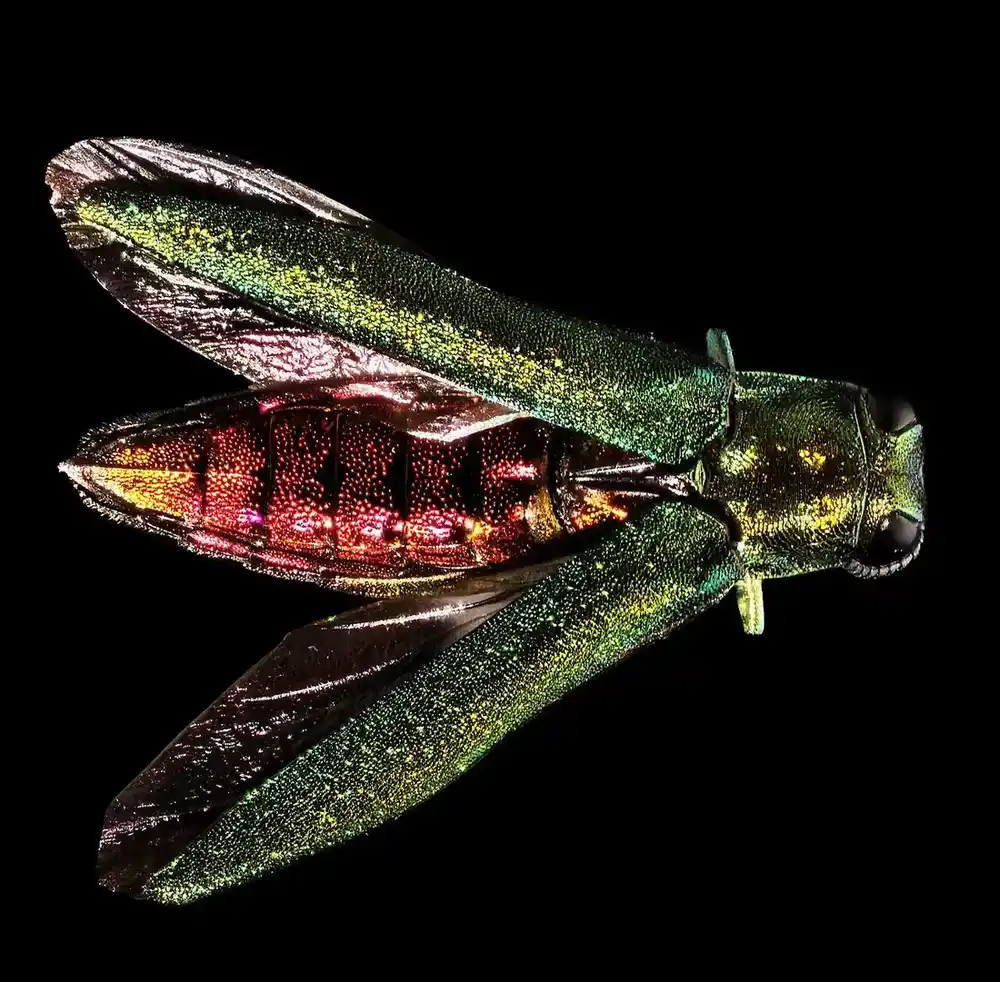
The emerald ash borer deserves its own paragraph because it is rewriting Wichita's canopy. The beetle's larvae feed under the bark, cutting the tree's plumbing in ribbons; the tree dies over two to four years from the top down. Systemic trunk treatments protect a sound ash on a repeating cycle - an ongoing program, like a prescription, that only works while enough crown remains to move the treatment through the tree.

Soil is the quieter half of tree medicine here. Wichita's alkaline clays lock iron away from the species that crave it, construction compacts root zones into pavement-grade density, and grade changes bury root flares a fatal foot deep. Air-spade excavation, vertical mulching, flare recovery and honest watering plans cure more Wichita trees than any spray ever sold - because more Wichita trees are dying of their ground than of their pests.

Every treatment has a window, and the windows run on the pest's calendar, not the owner's: bagworm spray works on young larvae in early summer and barely touches the grown bags; oak wilt is prevented by winter pruning and root-graft discipline, not cured in July; borer treatment starts before symptoms in a tree worth keeping. The health visit's real product is that calendar, fitted to your trees.

Tree Health & Disease Treatment Through the Wichita Year

Wichita winters swing: bright mild weeks, then an ice storm or a hard freeze. Ice loads limbs past their breaking weight, frozen wood turns brittle, and the trees with split unions and dead tops are the ones that come down. Winter is the best pruning season here - structure is visible, disease pressure is low, and the trees read in winter get fixed before the spring storms interview them.

Spring is storm season in Wichita, and it is tree season too. From March into June, supercell thunderstorms roll off the plains with damaging wind, and the trees that get a structural look before the season are the ones that come through it standing. Late spring is also when winter's hidden damage declares itself - limbs that died under ice, crowns that leaf out thin, and borers resuming their work in the ash.

Fall is the assessment and planting window. The severe season is past, the canopy shows its true structure as the leaves thin, and there is time to cable what can be kept, remove what cannot, and plant replacements while the soil is still warm. It is also when honest tree work happens, because a bare-crowned tree hides nothing from an arborist.

Tree Health & Disease Treatment in Depth

Tree medicine runs on a rule owners find austere: treatment protects the healthy remainder; it does not rebuild the lost. The systemic that saves a full-crowned ash cannot re-leaf a crown the borer has eaten, and the soil work that rescues a compacted oak cannot un-compact a decade overnight. Every honest health program is therefore a measurement first - how much sound tree is left - and a calendar second.

That is also why the diagnosis outranks the treatment in value. Kansas decline is a crowded differential: borers, wilts, chlorosis, root disease, soil and drought all present as the same tired crown. The visit that separates them - by the base's flare, the trunk's seams, the leaf's pattern, the site's history - is the visit that decides whether the treatment money is spent on the tree's actual enemy or on its most famous one.

Choosing the Right Help

Health work is chosen on diagnosis or not at all. The professional to hire names the pest, disease or soil condition, shows you its evidence on your tree, states the treatment's realistic outcome and its window - and will tell you when the tree in front of you is past treating. Anyone selling a spray program before naming the enemy is selling the spray, not the outcome.

The Climate Behind It

Wichita sits on the central Kansas plains where the Arkansas and Little Arkansas rivers meet, and plains weather writes the tree calendar here: spring severe storms with damaging wind, winters that deliver canopy-breaking ice, and long summer droughts broken by downpours. A tree in Wichita is not tested by one climate - it is tested by all of them, in turns, every year of its life.

Wind is the signature force. Kansas wind works at trees day after day - flagging crowns, fatiguing weak unions - and storm outflows arrive with gusts that collect on whatever the daily wind loosened. A tree's structure, built by its pruning history or its neglect, is its real storm rating, whatever species the tag said.

How Tree Health & Disease Treatment Works

Diagnose before anything is sold

The tree is examined - crown, trunk, base, roots, site - and the cause named with the evidence shown. If the cause is not treatable, you hear that first, before any program is priced.

Rank the options honestly

Treat, manage, monitor or remove - with what each path realistically buys. A program that only postpones a removal is presented as exactly that.

Treat in the window

Applications, injections, soil work or pruning are scheduled to the pest's and the tree's calendar - the timing is not a detail, it is the treatment.

Monitor on a schedule

Health programs include the look-backs: crown density checked season over season, so the plan is adjusted by evidence, not by hope.

Doing It Yourself vs a Professional

The DIY Route

  • Spraying an undiagnosed tree treats your worry, not the tree's borer, fungus or soil
  • Trunk injections bought online, drilled by guesswork, wound the tree and dose it wrong in one purchase
  • Fertilizing a chlorotic tree with more nitrogen greens the lawn around a tree still starving for iron
VS

The Professional Route

  • Names the cause and shows the evidence before naming a product
  • Runs treatments on the pest's calendar and tells you when the window has already closed
  • Treats soil and roots as medicine, not as an upsell - because in Kansas they usually are the medicine

Keep It From Coming Back

Half of tree medicine is administered by the owner's hose, mulch fork and calendar discipline. The list below is that half - the habits that keep treatable trees treatable and sound trees sound.

  • Start ash decisions now: inventory your ash, choose the keepers while their crowns are full, and budget the program or the removal - but do not drift.
  • Prune oaks in winter only, and paint oak wounds immediately in the growing season if they happen - oak wilt discipline is cheap and absolute.
  • Mulch wide and shallow over root zones, keep the flare visible, and never let a grade change bury a trunk.
  • Water deeply in drought, especially young trees and chlorotic ones; a stressed tree is every pest's invitation.
  • Buy local firewood and move none from infested ground - the borer travels in the firewood pile farther than it flies.
  • Have thin-crowned trees diagnosed the first season it happens - the treatment window is the first chapter of every success story.
Tree Health & Disease Treatment in the Surrounding Communities

The communities around Wichita share its storm tracks and its ice - with their own twists of storm history, acreage timber and open-country wind.

Tree Health & Disease Treatment in Clearwater

Clearwater is a small railroad-era city southwest of Wichita on the Chikaskia River, with a historic downtown and a mix of older homes and new subdivisions drawing commuters to the metro. Its older streets keep a small-town canopy of elm and hackberry planted generations back.

Tree Health & Disease Treatment in Mulvane

Mulvane is an old railroad town south of Wichita on the Arkansas River, with a preserved Main Street and depot, newer growth near the Kansas Star Casino, and a strong small-city identity. The river's bottomland timber frames the town on its low sides.

Tree Health & Disease Treatment in Rose Hill

Rose Hill is a growing Butler County town southeast of Wichita, where newer subdivisions and acreage homes have spread around its schools. It draws families who want country space within commuting range - and its trees split between new plantings and old farm timber.

Tree Health & Disease Treatment in Bel Aire

Bel Aire is a growing city on Wichita's north edge, built around lakes, parks and newer subdivisions along the K-254 corridor. It has grown from a small community into one of the metro's active family suburbs, planting its canopy as it goes.

Where Tree Health & Disease Treatment Is Needed Most

In the historic core and the east side - Riverside, College Hill, Eastborough, Downtown Wichita, Old Town and Delano, Midtown, South Wichita, Planeview, Oaklawn - the canopy runs from Wichita's oldest planted elms and oaks to the boom-decade ash and pear of the postwar subdivisions, and tree health & disease treatment follows that record: heritage structure work on the older streets, species failure calendars in the subdivisions, and wind exposure that grows toward the open edges.

Across the east and west growth sides and the north side - East Wichita, Northeast Wichita, Uptown Wichita, West Wichita, Southwest Wichita, Auburn Hills and North Wichita, Benjamin Hills, Northwest Wichita, Derby, Andover, Haysville - sit the subdivision waves of the 1970s onward, the growth-edge neighborhoods and some of the county's busiest storm tracks, which together make this the steadiest tree health & disease treatment territory in the city.

Beyond the city line, the same work runs in Clearwater, Mulvane, Rose Hill, Bel Aire, Park City, Valley Center, Kechi, Maize, Goddard, Newton, Hutchinson - railroad towns, fast-growing suburbs and county-seat communities where acreage timber, shelterbelts and open-country exposure add their own chapters. Every one of these area pages carries the local detail for tree health & disease treatment in that community.

Tree Health & Disease Treatment by Neighborhood

Every area we serve has its own Tree Health & Disease Treatment page with local detail.

Coverage, In Full

Tree Health & Disease Treatment runs across the whole service map: Riverside, College Hill and Eastborough; Downtown, Old Town, Delano and Midtown; East Wichita, the northeast growth edge and Uptown; South Wichita, Planeview and Oaklawn; the west side, Southwest Wichita and Auburn Hills; North Wichita, Benjamin Hills and Northwest Wichita; and beyond the city in Derby, Andover, Haysville, Clearwater, Mulvane, Rose Hill, Bel Aire, Park City, Valley Center, Kechi, Maize, Goddard, Newton and Hutchinson. One call covers all of it - the local pages above carry the detail for each. If your street is not named here, call anyway: routes grow with demand, and most Sedgwick County addresses are already within reach of a scheduled run.

From the Wichita Tree Guides

Stump Grinding vs Stump Removal: Which Does Your Yard Need?

Grinding retires the stump below grade without tearing the yard apart - it answers most yards; removal evicts the whole root ball, and answers ground that must be provably clear. Decide by the ground's next job: lawn and beds take grinding; foundations, pools, and an exact-footprint replanting take removal - everything else is taste and budget.

Read the Guide

When to Trim: A Kansas Tree Trimming Calendar

Late winter is the plains' great pruning window - dormant wood, visible structure, inactive disease beetles - but every species keeps one date of its own. Spring bloomers are pruned right after flowering, oaks in the cold months only, and deadwood and hazards on the day they are found, in any month at all.

Read the Guide

Tree Health & Disease Treatment Questions

How long do borer treatments protect a tree?

Systemic trunk treatments run on a repeating cycle - commonly every two to three years depending on the product and the tree's size - for as long as the tree is kept. It is a program, not a one-time cure: the protection lapses when the cycle lapses, and the assessment each round confirms the tree is still sound enough to be worth protecting.

Can a treated tree still be lost?

Yes - treatment protects against the named pest; it does not renew storm-split structure, reverse advanced decay, or water the tree in a drought. And a tree treated too late can decline anyway, which is why honest programs start with the crown measurement and keep measuring. Health work manages probabilities, and says so.

Are the treatments safe around kids, pets and gardens?

Trunk-injected systemics stay inside the tree's plumbing, which is precisely why they are the standard near homes - no canopy-wide spray drift. Soil treatments are placed in the root zone and watered in. The applicator states the product, the method and any re-entry guidance for your specific program; ask, and expect a straight answer.

What affects the cost of tree health work in Wichita?

The diagnosis's depth, the treatment method (a trunk injection program for one ash against a soil-recovery project for a row of oaks), the number of trees, and the cycle's length. Health work is priced as a program with look-backs included - and it starts with the diagnostic visit, whose findings decide whether treatment money is money well spent at all.

Can my Wichita ash tree be saved from the emerald ash borer?

If its crown is still substantially full and its structure sound, a systemic treatment program can protect it indefinitely, renewed on its multi-year cycle. If the borer has taken a third or more of the crown, treatment rarely restores it, and the honest money goes to removal and replanting. The assessment measures the crown and the borer sign, and the answer follows the measurement - which is why the look should happen before the thinning you can see from the street.

Why are my Wichita pin oak's leaves yellow every summer?

Almost always iron chlorosis: Wichita's alkaline soils lock iron in a form the tree cannot use, so new leaves come in yellow between green veins. The fixes run from soil acidification and chelated iron treatments to, in stubborn ground, accepting the tree is in the wrong soil and planning its succession. It weakens the tree yearly, so it is worth treating as a condition, not a quirk.

Is oak wilt in Wichita, and how do I protect my oaks?

Oak wilt is established in Kansas and moves two ways: beetles carrying spores to fresh wounds in the warm months, and root grafts between neighboring oaks underground. Protection is discipline - prune only in winter, paint any warm-season wound the day it happens, and never move oak firewood from a dead tree. A wilting red oak in June is a call-now diagnosis; whites resist longer, reds can die in weeks.

My Wichita tree looks sick but I do not know why. Where do I start?

With the ground, honestly: most unexplained decline in Wichita traces to roots and soil - compaction, buried flares, girdling roots, drought debt - with pests arriving second to feed on the weakened. The diagnostic visit reads base and site before crown and sprayer, because treating a soil problem with a pesticide is the most expensive way to learn the difference.

Please note: Wichita Tree Service is an independent directory and referral service, not a tree service contractor. The professionals reachable through this site are independent businesses; any agreement for work is between you and the professional you engage. Service information on this site is general educational material - the scope of any real tree work is set by an on-site inspection.

A Dead Limb Over the Roof, a Leaning Trunk or Storm Debris in the Yard?

One call connects you with a tree care professional serving Wichita and the surrounding communities - assessment, trimming, removal and cleanup.

📞 Call Now
📞 Call Now