Debris & Firewood Removal in South Wichita
Debris & Firewood Removal for South Wichita homes - local conditions, a clear process, and one call to get it started.
Every debris & firewood removal call in South Wichita opens the same way: read the tree, then read the neighborhood around it.
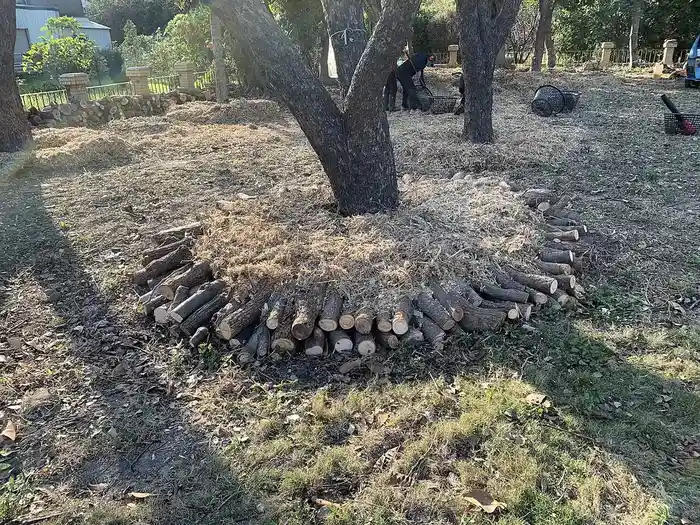
Old wood piles carry their own ecology in South Wichita: a brush stack is housing for pests and a ladder for fire; a firewood stack against the house is a termite bridge with a welcome mat. Hauling the junk and stacking the keepers properly - off the ground, away from the siding, covered on top - is pest control disguised as tidiness.
South Wichita grew along the Pawnee and Broadway corridors as a working-class side of the city, with Pawnee Prairie Park and the Cowskin Creek greenbelt at its heart. Its tree story is a storm story: the May 1999 tornado and the April 2012 tornado both crossed this side of town, and the canopy has been regrowing - and being replanted - ever since.
Local conditions shape the work here. Postwar ranch and minimal-traditional homes, many re-landscaped in waves after the storm years - and that shapes the tree work directly. Two tornado paths crossed here thirteen years apart, so South Wichita's trees come in age bands: the pre-1999 survivors, the post-1999 plantings now at mid-size, and the fast fill-ins - Bradford pears and silver maples - planted for quick shade that are now splitting on schedule. For debris & firewood removal in South Wichita, debris calls here start with the scatter pattern - size, spread and what the trees still hold.
From Pawnee Prairie Park along the Cowskin Creek outward, South Wichita is a sequence of planting decisions made decades ago - and debris & firewood removal is how the present collects on them.
Signs South Wichita Homes Need Debris & Firewood Removal
Rounds too big to split by hand
Trunk sections from a removal, lying where they fell - too heavy to move, too big for the stove, slowly hosting fungus.
A firewood stack against the house
Wood stacked on the siding is a pest highway and a moisture trap.
A dead tree's worth of fallen branches
Some yards accumulate a limb a storm at a time until the corners are all wood.
Why This Work Runs in South Wichita
Firewood craft is moisture craft. Green wood is half water by weight in the species that grow here; split, stacked off the ground with the top covered and the sides open, Kansas wind seasons a cord in a summer. The species ledger matters: oak, pecan, hickory and Osage orange are the dense, long-burning woods; elm and hackberry are honest mid-grade; cottonwood and willow are shoulder-season wood at best, and silver maple splits the difference along with your patience.
Two tornado paths crossed here thirteen years apart, so South Wichita's trees come in age bands: the pre-1999 survivors, the post-1999 plantings now at mid-size, and the fast fill-ins - Bradford pears and silver maples - planted for quick shade that are now splitting on schedule. Storm-weakened trees that were never assessed are the standing risk.
In South Wichita, that plays out street by street - for debris removal, watch the scatter - the yard tells the storm's story in pieces. The South Wichita file, in one line: know the unions, know the bases, and the work list shortens itself.
Spring's second act is the leaf-out audit. After the first warm weeks, the pattern repeats street by street: the crown that comes back thin, the limb that never leafs at all, the ash the borer spent the winter inside. Owners who walk their trees at leaf-out start their decisions from evidence; owners who skip it find out across the summer, one falling limb at a time.
On the day, expect the visit to start with questions and a walk-around, not a saw. The arborist confirms the problem, shows you the evidence - the crack, the thin quadrant, the fungus at the base - and explains the plan before any work begins, and you get the findings in writing when it is done.
The turning season rearranges exposure in South Wichita: the union that took the June wind is the union the first ice will interview in December.
One more preparation that matters on the plains: tell the office about any lines through the canopy, septic fields or new concrete on the property. What is under and over the tree shapes the method more than most homeowners expect.
How Debris & Firewood Removal Works in South Wichita
The full step-by-step process for this service - inspection, scope, the work itself and follow-up - is laid out on the main Debris & Firewood Removal page. In South Wichita the same sequence runs with the local map in hand: the canopy around Pawnee Prairie Park along the Cowskin Creek, the housing pattern described above, and the exposure this neighborhood actually carries.
The South Wichita Angle
Ask anyone who works trees in South Wichita and they will tell you the pattern repeats: the storm losses, the species failures, and the seasons grade the result. Housing here tells the arborist where to look first. Postwar ranch and minimal-traditional homes, many re-landscaped in waves after the storm years.
Layer the treetops on top and the job defines itself. Two tornado paths crossed here thirteen years apart, so South Wichita's trees come in age bands: the pre-1999 survivors, the post-1999 plantings now at mid-size, and the fast fill-ins - Bradford pears and silver maples - planted for quick shade that are now splitting on schedule. Storm-weakened trees that were never assessed are the standing risk. So the debris & firewood removal visit here is built from the block outward: evidence first, structure and targets second, work matched to both.
South Wichita does not sit alone on the map. It weathers the same storms as Planeview, Oaklawn and Delano - the same cells cross the county, the same wind works the same canopies, and the same seasons move through all of them within the same few weeks. The borders on the map are postal, not meteorological - the weather commutes freely, so the tree care has to think in neighborhoods, not addresses.
On the route map, South Wichita sits in the wichita neighborhood group, ZIP 67211 - close enough to Planeview, Oaklawn that crews work them on the same runs. Crews working a route learn its trees - the repeat splits, the declining ash, the unions that go first - and debris & firewood removal gets better every run.
A note on timing that the local pattern makes plain: debris & firewood removal done in the quiet months is a different service from the same work done in the emergency weeks - same trade, same crew, but planned instead of reactive, and thorough instead of triaged.
Prevention That Helps in South Wichita
- Do not haul oak or ash wood to other properties - disease and borer travel in the truck bed.
- Keep the stack off the ground on rails or pallets; ground contact is rot and termites on a schedule.
- Burn the oldest wood first and rotate the stack; a pile is a queue, not a monument.
Postwar ranch and minimal-traditional homes, many re-landscaped in waves after the storm years.
Keep Exploring
Debris & Firewood Removal nearby:
- Debris & Firewood Removal in Planeview
- Debris & Firewood Removal in Oaklawn
- Debris & Firewood Removal in Delano
- Debris & Firewood Removal in Southwest Wichita
More services in South Wichita:
- Storm Damage Cleanup in South Wichita
- Tree Removal in South Wichita
- Hedge & Shrub Trimming in South Wichita
- Stump Removal in South Wichita
See the full tree care page for South Wichita and the Debris & Firewood Removal overview for Wichita.
Debris & Firewood Removal in South Wichita - Questions
Can you cut and stack the wood from my South Wichita tree removal?
Yes - that is the standard finishing option: trunk wood cut to fireplace lengths, split where needed, and stacked neatly in your chosen spot, off the ground and off the siding. Say so when the removal is scoped, because the disposition of the wood is chosen then, not improvised over the chipper's noise.
What wood from South Wichita trees is worth keeping for firewood?
The dense hardwoods: oak, pecan, hickory and Osage orange burn long and hot once seasoned; elm, hackberry and ash are solid mid-grade fuel. Cottonwood, willow and silver maple burn fast and light - worth it for shoulder seasons, not for the coldest weeks. Punky, hollow or insect-eaten wood is haul-away by any honest ledger.
How does Debris & Firewood Removal work around Pawnee Prairie Park along the Cowskin Creek?
The landmark matters because it concentrates the pattern - exposure, storm paths, and the neighborhood's planting era in one place. Debris & Firewood Removal visits in South Wichita read that pattern first: where the wind, ice and decline gather, the tree work follows, and the scope is drawn from it.
A Dead Limb Over the Roof, a Leaning Trunk or Storm Debris in the Yard?
One call connects you with a tree care professional serving Wichita and the surrounding communities - assessment, trimming, removal and cleanup.
📞 Call Now