Wichita Tree Services

Debris & Firewood Removal in Wichita, KS

Yard debris and firewood services in Wichita - brush piles, storm wood and old stacks hauled away, or sound wood cut, split and stacked neatly where you will burn it.

Ice is the second force, and it is patient. The great Kansas ice storms load every limb with weight the wood never evolved to carry, and the failures they cause - split trunks, torn crowns, whole trees down - arrive in a single night across whole neighborhoods. Species with brittle wood and trees with included bark pay first, which is why the canopy's composition matters as much as its size.

The tree stock matches the city's history: American elm and hackberry in the old neighborhoods, ash planted heavily in the boom decades, Bradford pears and silver maples planted for fast shade, and cottonwood, pecan and walnut timber along the river corridors. Each carries its own Wichita fate - the borer for the ash, the split for the pears, the shed limb for the cottonwoods - and the pages here are organized around exactly that.

Signs You Need Debris & Firewood Removal

A brush pile older than the season

Last spring's pruning mountain, still there: it compacts, harbors wasps and rodents, and grows a weed thicket through it. It will not improve with another year of decision-making.

Rounds too big to split by hand

Trunk sections from a removal, lying where they fell - too heavy to move, too big for the stove, slowly hosting fungus. A splitter and an hour turn them into inventory instead of landscape.

A firewood stack against the house

Wood stacked on the siding is a pest highway and a moisture trap. It needs to move - off the wall, off the ground - whether it stays as fuel or leaves as debris.

Storm wood still in the side yard

The cleanup after the cleanup: the trunk wood the emergency crew left stacked by agreement, now in the way of mowing, planting and everything since.

A dead tree's worth of fallen branches

Some yards accumulate a limb a storm at a time until the corners are all wood. A single haul returns the corners - and removes the ladder fuel a dry Kansas summer should not keep near a house.

Firewood of unknown age and species

The inherited stack: gray, light, punky in the middle. Sorted honestly, some of it burns, some of it is compost architecture. The sort is the service.

Why Debris & Firewood Removal Is a Standing Job in Wichita

Debris is a fire and pest equation before it is an eyesore. Kansas summers cure brush piles to kindling, and a pile against a fence or under a tree is a fuse laid through the yard. The same stack is winter housing for the neighborhood's rodents and wasps. Hauling is therefore not cosmetic: it is the removal of habitat and fuel, and it is priced like the simple work it is because that is what it is.

Firewood craft is moisture craft. Green wood is half water by weight in the species that grow here; split, stacked off the ground with the top covered and the sides open, Kansas wind seasons a cord in a summer. The species ledger matters: oak, pecan, hickory and Osage orange are the dense, long-burning woods; elm and hackberry are honest mid-grade; cottonwood and willow are shoulder-season wood at best, and silver maple splits the difference along with your patience.

There is also a disease etiquette to wood: oak from a wilt-killed tree and ash from borer ground are not souvenirs to haul to the lake lot. Infected wood moved is infection delivered. A debris crew that knows the local diseases stacks, hauls and disposes accordingly - and will tell you which of your piles should never travel.

Debris & Firewood Removal Through the Wichita Year

Fall is the assessment and planting window. The severe season is past, the canopy shows its true structure as the leaves thin, and there is time to cable what can be kept, remove what cannot, and plant replacements while the soil is still warm. It is also when honest tree work happens, because a bare-crowned tree hides nothing from an arborist.

Summer splits in two: the storm tail of June and early July, when late cells still tear at crowns, and the long bake that follows, when drought stress shows first in the trees planted in tight soil and parking-lot islands. Most storm damage is discovered in summer - the storm did the work in spring, and the failures report as the heat and wind finish them. Deep watering of young trees is the season's quiet essential.

Spring is storm season in Wichita, and it is tree season too. From March into June, supercell thunderstorms roll off the plains with damaging wind, and the trees that get a structural look before the season are the ones that come through it standing. Late spring is also when winter's hidden damage declares itself - limbs that died under ice, crowns that leaf out thin, and borers resuming their work in the ash.

Debris & Firewood Removal in Depth

Wood debris is a property's unedited draft: it shows what the trees did, what the storms did, and what the owner deferred. Clearing it is not tidiness for its own sake - it is the removal of pest habitat, fire load and mower hazards, and the recovery of corners the property had quietly surrendered. Judged as risk work, a debris haul is among the simplest risk reductions a yard can buy.

The firewood side runs on a parallel honesty. A stack is a winter's heat measured in advance, and its value is set by species, split and seasoning - three facts a sorting visit establishes in minutes. Owners who know their stack's true arithmetic heat their homes on purpose; owners who inherit folklore burn punky cottonwood in January and blame the stove.

Choosing the Right Help

Debris work is chosen on the sort. The honest crew walks the piles with you and separates fuel from freight in front of you, names what it will not move for disease reasons, and prices the load as it stands. If the quote treats your seasoned oak and your punky brush pile as the same material, it is a hauling guess - choose the crew that can tell them apart at a glance.

The Climate Behind It

Wichita sits on the central Kansas plains where the Arkansas and Little Arkansas rivers meet, and plains weather writes the tree calendar here: spring severe storms with damaging wind, winters that deliver canopy-breaking ice, and long summer droughts broken by downpours. A tree in Wichita is not tested by one climate - it is tested by all of them, in turns, every year of its life.

Wind is the signature force. Kansas wind works at trees day after day - flagging crowns, fatiguing weak unions - and storm outflows arrive with gusts that collect on whatever the daily wind loosened. A tree's structure, built by its pruning history or its neglect, is its real storm rating, whatever species the tag said.

How Debris & Firewood Removal Works

Sort the wood pile by pile

Keep, split, haul: every stack and brush pile is sorted with you - fuel value, pest state and disease etiquette decide its column.

Split and stack the keepers

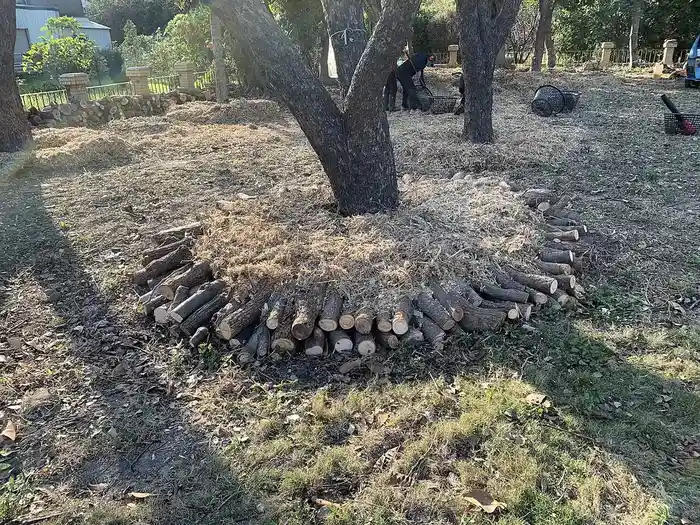
Rounds are split to stove size and stacked off the ground, top-covered, away from the house - a pile built like it means it.

Load and haul the rest

Brush chipped or loaded, junk wood hauled, the ground raked where the piles stood - corners and side yards returned to the property.

Leave the etiquette in writing

What was kept, how long it needs to season, and what never to move off the property - the note that keeps next year's pile honest.

Doing It Yourself vs a Professional

The DIY Route

  • Splitting elm or Osage orange rounds with a dull axe is a weekend that teaches anatomy, mostly your own
  • Burning a brush pile in a Wichita summer is a fire-ban violation and a neighbor-relations event in one match
  • Stacking green wood tight in a corner for 'next winter' grows mold architecture, not seasoned fuel
VS

The Professional Route

  • Sorts honestly - tells you which of your wood is fuel and which is freight, and why
  • Stacks for seasoning: off the ground, top covered, sides breathing, away from the siding
  • Knows the disease etiquette and will refuse to move infected wood across the county

Keep It From Coming Back

A yard stays clear the way a stack stays seasoned: by a small rhythm, not an annual rescue. The list below is the owner's share - the habits that keep corners from refilling.

  • Never stack firewood against the house or the fence - eighteen inches of air is the simplest pest control there is.
  • Keep the stack off the ground on rails or pallets; ground contact is rot and termites on a schedule.
  • Cover the top only; a fully tarped pile steams instead of seasoning.
  • Burn the oldest wood first and rotate the stack; a pile is a queue, not a monument.
  • Do not haul oak or ash wood to other properties - disease and borer travel in the truck bed.
Debris & Firewood Removal in the Surrounding Communities

The communities around Wichita share its storm tracks and its ice - with their own twists of storm history, acreage timber and open-country wind.

Debris & Firewood Removal in Clearwater

Clearwater is a small railroad-era city southwest of Wichita on the Chikaskia River, with a historic downtown and a mix of older homes and new subdivisions drawing commuters to the metro. Its older streets keep a small-town canopy of elm and hackberry planted generations back.

Debris & Firewood Removal in Mulvane

Mulvane is an old railroad town south of Wichita on the Arkansas River, with a preserved Main Street and depot, newer growth near the Kansas Star Casino, and a strong small-city identity. The river's bottomland timber frames the town on its low sides.

Debris & Firewood Removal in Rose Hill

Rose Hill is a growing Butler County town southeast of Wichita, where newer subdivisions and acreage homes have spread around its schools. It draws families who want country space within commuting range - and its trees split between new plantings and old farm timber.

Debris & Firewood Removal in Bel Aire

Bel Aire is a growing city on Wichita's north edge, built around lakes, parks and newer subdivisions along the K-254 corridor. It has grown from a small community into one of the metro's active family suburbs, planting its canopy as it goes.

Where Debris & Firewood Removal Is Needed Most

In the historic core and the east side - Riverside, College Hill, Eastborough, Downtown Wichita, Old Town and Delano, Midtown, South Wichita, Planeview, Oaklawn - the canopy runs from Wichita's oldest planted elms and oaks to the boom-decade ash and pear of the postwar subdivisions, and debris & firewood removal follows that record: heritage structure work on the older streets, species failure calendars in the subdivisions, and wind exposure that grows toward the open edges.

Across the east and west growth sides and the north side - East Wichita, Northeast Wichita, Uptown Wichita, West Wichita, Southwest Wichita, Auburn Hills and North Wichita, Benjamin Hills, Northwest Wichita, Derby, Andover, Haysville - sit the subdivision waves of the 1970s onward, the growth-edge neighborhoods and some of the county's busiest storm tracks, which together make this the steadiest debris & firewood removal territory in the city.

Beyond the city line, the same work runs in Clearwater, Mulvane, Rose Hill, Bel Aire, Park City, Valley Center, Kechi, Maize, Goddard, Newton, Hutchinson - railroad towns, fast-growing suburbs and county-seat communities where acreage timber, shelterbelts and open-country exposure add their own chapters. Every one of these area pages carries the local detail for debris & firewood removal in that community.

Debris & Firewood Removal by Neighborhood

Every area we serve has its own Debris & Firewood Removal page with local detail.

Coverage, In Full

Debris & Firewood Removal runs across the whole service map: Riverside, College Hill and Eastborough; Downtown, Old Town, Delano and Midtown; East Wichita, the northeast growth edge and Uptown; South Wichita, Planeview and Oaklawn; the west side, Southwest Wichita and Auburn Hills; North Wichita, Benjamin Hills and Northwest Wichita; and beyond the city in Derby, Andover, Haysville, Clearwater, Mulvane, Rose Hill, Bel Aire, Park City, Valley Center, Kechi, Maize, Goddard, Newton and Hutchinson. One call covers all of it - the local pages above carry the detail for each. If your street is not named here, call anyway: routes grow with demand, and most Sedgwick County addresses are already within reach of a scheduled run.

From the Wichita Tree Guides

After the Storm: A Wichita Guide to Storm-Damaged Trees

Storm damage keeps unfolding after the sky clears: hangers fall, splits open, and root plates settle for days - the first walk should be a look, never a cleanup. Work the order: safety and lines first, photographs of everything as found, hazards handled by crews, and the standing trees assessed before any verdicts get casual.

Read the Guide

When to Trim: A Kansas Tree Trimming Calendar

Late winter is the plains' great pruning window - dormant wood, visible structure, inactive disease beetles - but every species keeps one date of its own. Spring bloomers are pruned right after flowering, oaks in the cold months only, and deadwood and hazards on the day they are found, in any month at all.

Read the Guide

How Long Do Trees Live in Kansas?

The same species lives decades less in Kansas than in a calm climate - wind load, ice storms and drought spend a tree's life faster than time alone ever will. Know each species' realistic range, grade your trees by structure and health rather than birthday, and plan renewals and successions as the mid-life events they are.

Read the Guide

Debris & Firewood Removal Questions

What is a cord, honestly?

A stack four feet high, four feet deep and eight feet long - 128 cubic feet of stacked wood, air gaps and all. A pickup load is a fraction of one; a 'face cord' is a single row of that stack. Honest wood talk uses the full cord as its unit and says what fraction you actually have - your winter planning deserves arithmetic, not folklore.

Can storm wood be kept for firewood?

Sound storm wood, yes - the species rules apply unchanged. Wood from split, twisted trunks splits unevenly and should be cut with respect for its stored tension; wood from diseased trees follows the etiquette (oak wilt and borer ash stay local and get burned first, never gifted across the county). The sort names which of yours qualifies.

Do you chip brush or haul it whole?

Volume and access decide: chipping on site turns a brush mountain into a manageable mulch pile (yours to keep or haul), while tight access or enormous volume favors load-and-haul. Either way the price is set by the pile as it stands - bring honest dimensions or let the walk measure it.

What affects the cost of debris and firewood work in Wichita?

Volume and weight first, then the split between services - splitting and stacking is handwork, chipping is machine work, hauling is trips. Access matters (a pile the truck can back to is a different job than a pile behind a garden gate), and diseased wood's disposal carries its own rules. The walk sorts it into one clear number.

Can you cut and stack the wood from my Wichita tree removal?

Yes - that is the standard finishing option: trunk wood cut to fireplace lengths, split where needed, and stacked neatly in your chosen spot, off the ground and off the siding. Say so when the removal is scoped, because the disposition of the wood is chosen then, not improvised over the chipper's noise.

What wood from Wichita trees is worth keeping for firewood?

The dense hardwoods: oak, pecan, hickory and Osage orange burn long and hot once seasoned; elm, hackberry and ash are solid mid-grade fuel. Cottonwood, willow and silver maple burn fast and light - worth it for shoulder seasons, not for the coldest weeks. Punky, hollow or insect-eaten wood is haul-away by any honest ledger.

How long does firewood need to season in Wichita?

Split and stacked properly, most Kansas hardwoods season across one summer of wind - six to nine months for oak to be at its best, less for elm and ash. Whole rounds season at a fraction of that pace, which is why splitting happens now rather than in November. A moisture reading under twenty percent is the burn-ready line.

Will you haul away just a brush pile in Wichita, with no other work?

Yes - debris hauling stands alone as a service: brush piles, old stacks, storm remnants, the side-yard accumulation. The load is measured as it stands, chipped or hauled as the volume dictates, and the ground where it sat is raked back to yard. Small job, same standard: the corner is returned, not just emptied.

Please note: Wichita Tree Service is an independent directory and referral service, not a tree service contractor. The professionals reachable through this site are independent businesses; any agreement for work is between you and the professional you engage. Service information on this site is general educational material - the scope of any real tree work is set by an on-site inspection.

A Dead Limb Over the Roof, a Leaning Trunk or Storm Debris in the Yard?

One call connects you with a tree care professional serving Wichita and the surrounding communities - assessment, trimming, removal and cleanup.

📞 Call Now
📞 Call Now